TradingKey - U.S. annualized PCE growth in August slowed to 3.4%, pushing U.S. Treasury yields lower, while U.S. stocks traded mixed, with large-cap tech stocks leading gains.
At the close, the Dow Jones Industrial Average fell 0.86% to 50,906.05; the Nasdaq Composite Index rose 0.24% to 26,861.06; and the S&P 500 Index fell 0.25% to 7,651.54.
Tech Stock Performance
Intel (INTC) rose 3.71% to $120.23.
TrendForce's latest report shows that CPU lead times have extended from the usual 16-20 weeks to 25-30 weeks, directly attributing this change to the demand boost for CPUs driven by AI agents such as Muse. This marks the first direct evidence at the supply chain level of AI agents impacting CPUs. Previous discussions about Muse mostly focused on user growth and conceptual deduction; now, the significant lengthening of lead times indicates that the squeeze on hardware infrastructure from AI agents has spread from GPUs to CPUs.
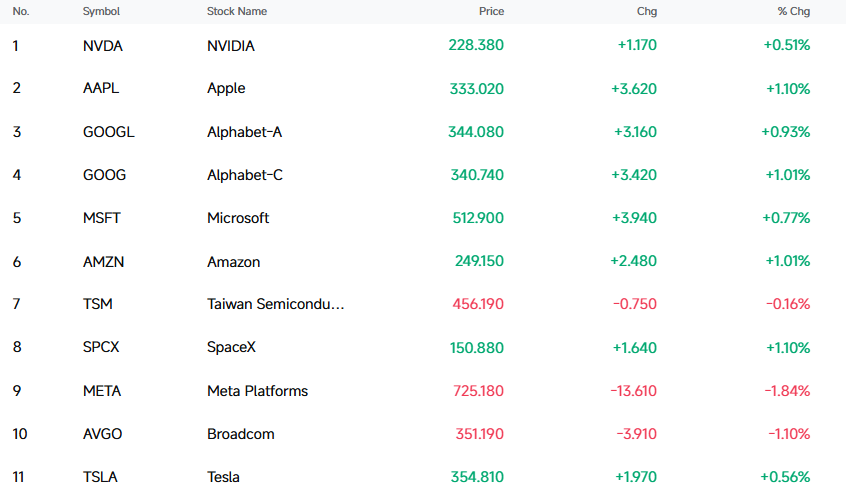
Among mega-cap tech stocks, Apple (AAPL) rose 1.10%, SpaceX (SPCX) gained 1.10%, Amazon (AMZN) rose 1.01%, Google (GOOGL) gained 0.93%, Microsoft (MSFT) advanced 0.77%, Tesla (TSLA) rose 0.56%, and Nvidia (NVDA) added 0.51%. On the downside, Meta Platforms (META) fell 1.84%, Broadcom (AVGO) dropped 1.10%, and TSMC (TSM) slipped 0.16%.
[Source: FutuBull]
The Philadelphia Semiconductor Index closed nearly flat at $12628.59. Among its 30 constituents, 14 advanced and 16 declined.
Company News
FTC Launches Comprehensive Investigation into Superintelligent Model Companies Including Anthropic and OpenAI
According to The New York Times, government officials revealed that the U.S. Federal Trade Commission (FTC) is stepping up efforts to conduct a comprehensive investigation into Anthropic, OpenAI, and other superintelligent model companies to determine the potential risks these technologies may pose to consumers. The agency plans to issue mandatory formal demands (similar to subpoenas) to these tech giants, ordering them to submit relevant information. FTC Chairman Andrew Ferguson initiated the investigation prior to the "Hugging Face incident." The probe focuses on alleged "unfair or deceptive acts or practices" in violation of the FTC Act and will require these AI (or "SI", as Trump calls them) companies to submit relevant documents.
Scale of Anthropic-SpaceX Compute Agreement Revealed, Reaching Up to $84.5 Billion, Doubling Previous Disclosure
According to a Reuters report on Tuesday, a confidential IPO prospectus from Anthropic shows that the company signed a computing power lease agreement with SpaceX, with a total maximum value of up to $84.5 billion extending through 2029. In May this year, SpaceX disclosed in its own IPO filings that Anthropic agreed to lease its Nvidia chip-based computing power for $1.25 billion per month for up to three years, totaling about $45 billion. At the time, both parties stated that the agreement could be canceled with 90 days' written notice. The newly disclosed $84.5 billion is nearly double that figure. The report noted that most terms in the new agreement also retain the 90-day cancellation clause.
Industry & Macro News
US Consumer Spending Posts Largest Gain in a Year, Core PCE Rises 0.2%
US consumer spending grew at its fastest pace in over a year in August, continuing to power the economy amid persistent inflationary pressures. According to data released by the US Bureau of Economic Analysis on Wednesday, inflation-adjusted personal spending rose 0.6% month-on-month in August, marking the largest single-month gain since March 2025. The Federal Reserve's preferred inflation gauge—the Personal Consumption Expenditures (PCE) price index—rose 0.3% month-on-month in August. Excluding food and energy, the core PCE price index rose 0.2%.
US Senate Data Center Electricity Bill Blocked as Power Prices Become Midterm Election Focus
Amid partisan debate in the US Senate over artificial intelligence data centers and electricity costs, a Republican-backed data center bill failed to clear a procedural vote on Wednesday. The legislation would require state utility regulators to consider measures to prevent new data centers from driving up residential electricity prices. In the Senate vote, the bill fell short of the 60-vote threshold needed to advance, passing 57 to 43, with only four Democratic senators voting in favor. Senate Democratic Leader Chuck Schumer criticized the bill as a "political stunt," saying it merely proposed voluntary standards without requiring regulators to take actual action. Republicans countered that the bill aims to address public concerns over rising electricity costs driven by data centers, noting it had previously passed the House with near-unanimous support. As AI data center construction accelerates and power demand surges, the issue has become a key topic in the US midterm elections. According to an analysis by The Cook Political Report based on AdImpact data, political ad spending involving data center issues has exceeded $53 million.
Find out more