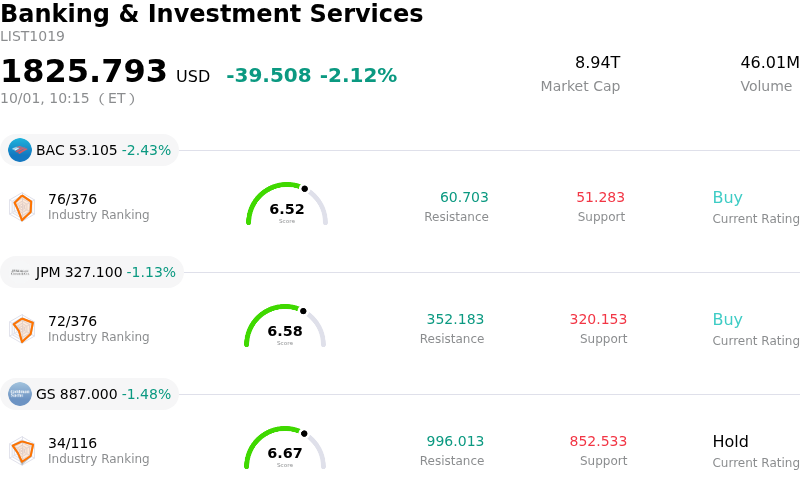
Mizuho Financial Group Inc (MFG) moved down by 4.34%. The Banking & Investment Services sector is down by 2.12%. The company underperformed the industry. Top 3 stocks by turnover in the sector: $Bank of America Corp(BAC-N)$ (BAC) down 2.51%; JPMorgan Chase & Co (JPM) down 1.13%; Goldman Sachs Group Inc (GS) down 1.48%.
What is driving Mizuho Financial Group Inc (MFG)’s stock price down today?
Mizuho Financial Group experienced notable downside pressure as structural market tailwinds subsided following the formal completion of its massive share repurchase program at the close of September. With the bank finishing its multi-billion yen buyback authorization ahead of the scheduled share cancellation, the open market lost a consistent source of daily institutional buying support. Following a strong multi-month rally fueled by Bank of Japan interest rate hikes and upgraded full-year earnings guidance, investors used the conclusion of the buyback as an opportunity to lock in profits, triggering a wave of profit-taking across both domestic shares and American Depositary Receipts.
Macroeconomic headwinds and currency market volatility further compounded the intraday decline. Fluctuations in benchmark sovereign bond yields alongside shifts in the U.S. dollar and Japanese yen exchange rate created sector-wide pressure on international financial institutions. As global markets absorbed shifting central bank expectations, risk appetite for cross-border banking equities diminished. Japanese megabanks, which had previously outperformed on domestic rate normalization narratives, faced broader sector rotations as institutional capital reassessed short-term yield differentials and foreign exchange risk.
Technical consolidation and quarterly portfolio adjustments also intensified the downward move. With technical indicators signaling overbought conditions following recent multi-year highs, algorithmic trading and momentum strategies triggered automated sell signals. Additionally, the turn of the quarter prompted institutional asset managers to rebalance portfolios and adjust financial sector allocations. Although Mizuho's fundamental outlook remains supported by widening net interest margins, strong capital ratios, and solid fee income, the expiration of buyback support combined with macro-driven risk aversion drove significant selling during the session.
Technical Analysis of Mizuho Financial Group Inc (MFG)
Technically, Mizuho Financial Group Inc (MFG) shows a MACD (12,26,9) value of -0.097, indicating a neutral signal. The RSI at 44.080 suggests neutral condition and the Williams %R at 86.478 suggests oversold condition. Please monitor closely.
Fundamental Analysis of Mizuho Financial Group Inc (MFG)
Mizuho Financial Group Inc (MFG) is in the Banking & Investment Services industry. Its latest annual revenue is $26.18B, ranking 19 in the industry. The net profit is $7.29B, ranking 16 in the industry. Company Profile
Over the past month, multiple analysts have rated the company as Strong Buy, with an average price target of $13.07, a high of $13.07, and a low of $13.07.
More details about Mizuho Financial Group Inc (MFG)
Company Specific Risks:
- Valuation Compression and Decelerating Growth: Recent institutional commentary emphasizes that Mizuho's past net income surge relied partly on temporary profit-boosting factors, placing normalized earnings below current headline guidance. With the stock trading near multi-year highs and earnings growth expected to moderate to single digits, any failure to sustain net interest margin expansion leaves MFG vulnerable to multiple contraction.
- Structural ROE Lag and Peer Scale Disadvantage: Mizuho continues to trail main Japanese megabank peers like Mitsubishi UFJ and Sumitomo Mitsui in Return on Equity (ROE) and retail banking scale. Lacking extensive consumer credit and leasing operations, MFG remains heavily dependent on wholesale banking, debt capital markets, and asset management, leaving top-line revenues more sensitive to institutional transaction volume slowdowns.
- Interest Rate Volatility and Domestic Credit Risk: While Bank of Japan monetary policy tightening expands net interest margins, higher domestic benchmark rates increase debt-servicing burdens on Japanese corporate borrowers. Elevated borrowing costs threaten to increase domestic credit costs and non-performing loans, while global yield curve shifts expose Mizuho's foreign securities portfolio to mark-to-market valuation losses.
- Capital Exposure to Corporate Cross-Shareholdings: Mizuho retains notable legacy equity cross-shareholdings with Japanese corporate clients. This portfolio structure ties a portion of the bank's regulatory capital base to broad domestic equity market performance, generating balance sheet drag and capital inefficiency during equity market pullbacks.
Find out more