Tracking the Market Trend
TradingKey - The 10-year and 30-year U.S. Treasury yields climbed to their highest levels since 2002, while weaker-than-expected U.S. consumer confidence weighed on the market. All three major U.S. stock indexes closed modestly lower. Some technology stocks rebounded, optical communications shares outperformed, and bank stocks lagged.
At the close, the Dow Jones Industrial Average fell 0.26% to 51,349.92; the Nasdaq Composite declined 0.09% to 26,797.54; and the S&P 500 slipped 0.17% to 7,670.84.
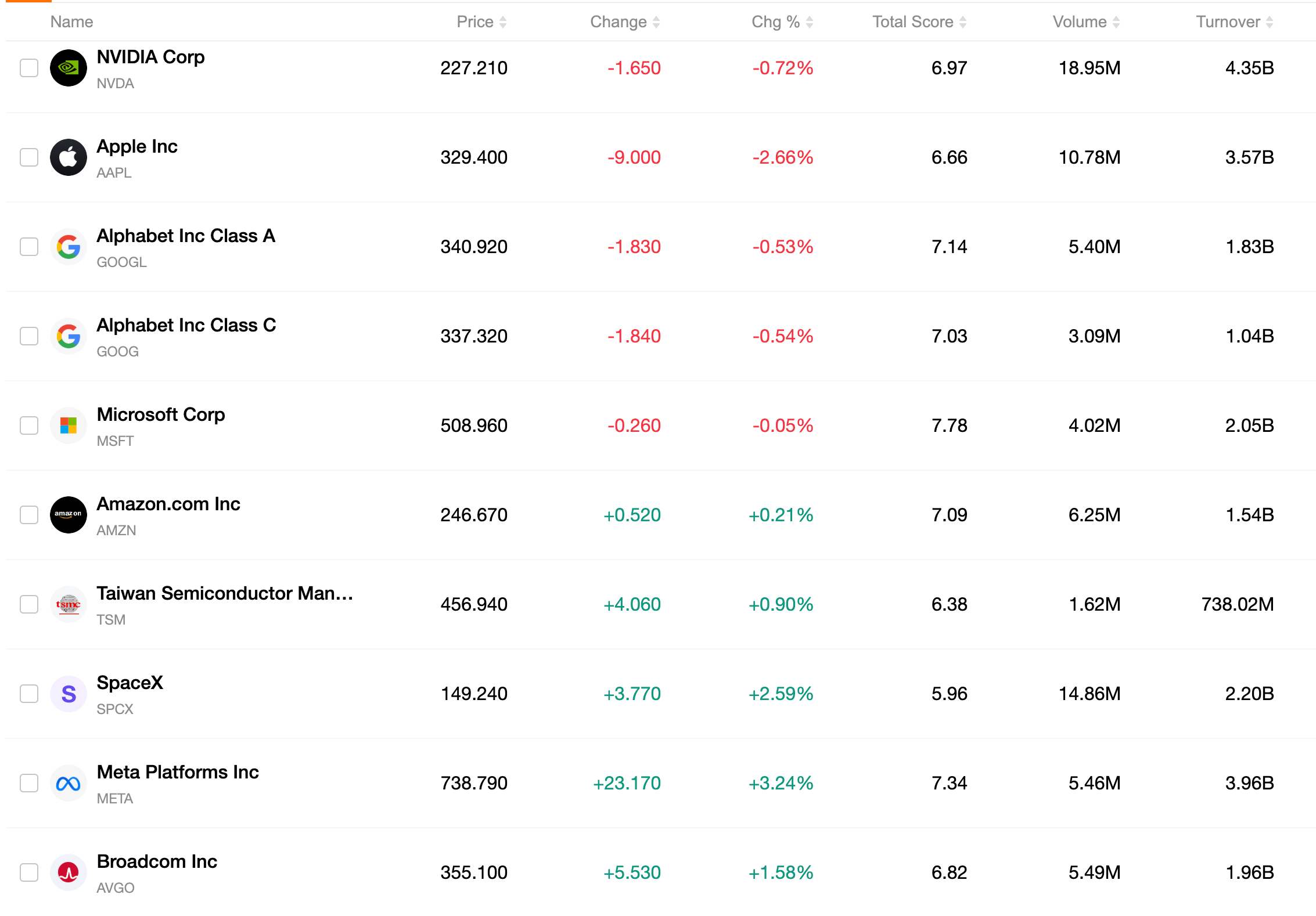
Among technology stocks, Meta (META) rose 3.24% to $738.79, while SpaceX (SPCX) gained 2.59% to $149.24. The Philadelphia Semiconductor Index advanced 1.32% to 12,629.16.
Optical communications stocks posted strong gains. Lumentum (LITE) climbed 5.66%, Corning (GLW) rose 4.68%, Marvell Technology (MRVL) gained 4.51%, and Applied Optoelectronics (AAOI) advanced 3.98%.
Oil prices declined as the gradual recovery of Middle Eastern crude shipments eased concerns over supply disruptions. November WTI crude futures fell 3.48% to $89.38 a barrel, while November Brent crude futures dropped about 2.6% to $102.59 a barrel.
Bitcoin briefly fell to around $82,500 before recovering above $83,000.
Market Headline
OpenAI’s annualized recurring revenue is approaching $70 billion, and Oracle’s stock rose more than 8% during intraday trading. According to Axios, citing people familiar with the matter, OpenAI’s annualized recurring revenue has grown by more than 70% since the beginning of the third quarter, and its enterprise sales have more than doubled since July. Following the news, Oracle’s stock rose as much as 8.3% during intraday trading and closed up 6.08%. Oracle has a large-scale cloud computing agreement with OpenAI, and OpenAI’s revenue growth helps alleviate market concerns about its demand for computing power and ability to fulfill contracts; however, Axios has not yet obtained data on OpenAI’s costs and cash expenditures.
OpenAI is reportedly seeking at least $30 billion in funding, targeting a valuation of approximately $1.4 trillion. Bloomberg, citing people familiar with the matter, reported that discussions are still in the early stages, and the final funding amount and valuation may be adjusted. OpenAI plans to raise additional capital through a new round of private financing; it had previously planned to go public in 2026, but CEO Sam Altman has ruled out the possibility of an IPO this year. This funding will support model R&D and computing power investments, though investors should remain mindful of equity dilution, cash burn, and infrastructure commitments.
OpenAI has launched the resident AI agent “Dots” and “GPT-6.1 Sol,” along with a new $500-per-month subscription plan. Powered by GPT-6 Astra, Dots can continuously perform tasks such as research, programming, and document processing in the cloud, positioning it as a direct competitor to Meta’s Muse. GPT-6.1 Sol is comparable to Astra in terms of programming, computer operations, and professional tasks, with standard API input and output pricing at about one-fifth that of Astra. The $500 monthly fee is part of the new ChatGPT Pro 500 plan and is not a standalone price for Dots; eligible Pro and Business Premium users receive one Dot, and pricing for additional Dots has not yet been announced.
Apple’s new CEO, John Ternus, is pushing for faster product development and a leaner organizational structure. According to Bloomberg, Ternus aims to reduce reliance on fixed spring and fall release cycles, increase the frequency of new product launches throughout the year, and flatten the management hierarchy between engineers and senior leadership. Apple’s hardware engineering team has recently laid off some project managers, and the Siri and Vision Pro teams have also undergone personnel adjustments. These plans are still in the implementation phase; the effectiveness of the reforms will be judged by product development cycles, organizational execution, and the performance of future products.
Top 10 Most Traded Stocks
The table below lists the ten most actively traded stocks in the latest market. Supported by massive trading volumes and exceptional liquidity, these assets have become key benchmarks for tracking global market dynamics.
Find out more